PegKeeperRegulator
The regulator contract supervises prices and other parameters telling whether the PegKeeper are allowed to provide or withdraw crvUSD.
PegKeeperRegulator.vyTechnically speaking, allowance is always granted but if certain checks do not pass, the Regulator will allow an amount of 0, which in return can be seen as not allowing anything to deposit or withdraw.
Providing
The Regulator will only grant allowance to the PegKeeper to provide crvUSD to the pool if the following requirements are met. If any of these conditions are not satisfied, the function will return 0, causing the transaction to ultimately revert:
- Providing is not paused: This is checked using the
is_killedmethod. If providing is paused, no crvUSD can be added to the pool. - Aggregated crvUSD price is higher than 1.0: The crvUSD price, obtained from the
aggregatorcontract, must be above 1.0 (10**18). If the price is equal to or below 1.0, providing crvUSD is not allowed. - Price consistency check: The
get_p(current AMM state price) andprice_oracle(AMM EMA Price Oracle) must be within a specified deviation range (price_deviation). This is to prevent spam attacks by ensuring that the current price is not significantly deviating from the oracle price. - Depeg threshold check: To ensure that the price of an asset has not depegged significantly, the current price is compared against a
worst_price_threshold. This check ensures that prices across the pools with PegKeepers are within an acceptable range of deviation. If the price deviation is within the threshold, the PegKeeper is allowed to provide crvUSD.
Additionally, the system has implemented limit ratios to ensure a balanced and stable distribution of debt among the PegKeepers. The formula used to calculate the maximum allowed debt ratio, , can be seen below. It dynamically adjusts the allowable debt ratio based on the aggregate debt of all PegKeepers in the system. These ratios can be plotted:
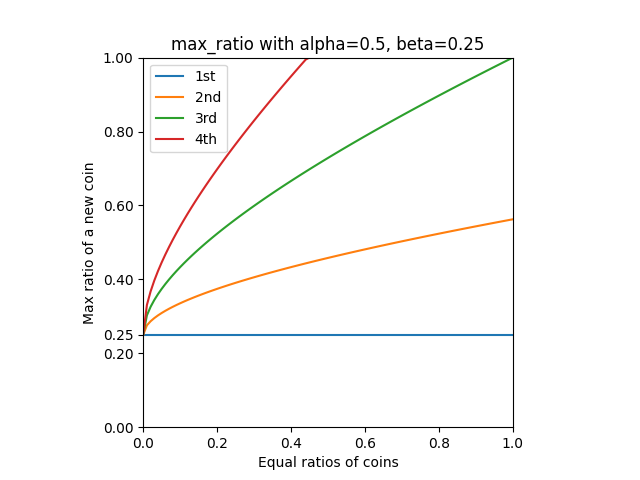
The allowed amount to provide and the max debt ratio to provide is calculated as follows:
Where:
- (\text{total}) is the sum of the debt and the balance of crvUSD held by the PegKeeper.
- (\text{debt}) is the current amount of crvUSD deposited into the pool by the PegKeeper.
- ( r_i ) represents the debt ratios of the other PegKeepers.
Let's take a look at the scenario when all PegKeepers are empty, therefore .
The maxRatio the PegKeeper can provide is 0.25. The actual crvUSD to provide is calculated as follows:1
To have full Desmos functionality and a cleaner overview, please view the graph directly on Desmos: https://www.desmos.com/calculator/szhqv2edsd.
provide_allowed
PegKeeperRegulator.provide_allowed(_pk: address=msg.sender) -> uint256Function to check how much crvUSD a PegKeeper is allowed to provide into a liquidity pool. If the PegKeeper is not permitted to provide any, the function will return 0.
This function may return a higher amount than the actual crvUSD that can be deposited, as it does not consider the current crvUSD balance of the PegKeeper. The returned value is capped by the maximum crvUSD balance of the PegKeeper in the _provide function of the PegKeeper itself.
| Input | Type | Description |
|---|---|---|
_pk | address | PegKeeper address; Defaults to msg.sender as the function is usually called by the PegKeeper itself |
Returns: amount of crvUSD allowed to provide (uint256).
<>Source code▼
struct PegKeeperInfo:
    peg_keeper: PegKeeper
    pool: StableSwap
    is_inverse: bool
    include_index: bool

peg_keepers: public(DynArray[PegKeeperInfo, MAX_LEN])

@external
@view
def provide_allowed(_pk: address=msg.sender) -> uint256:
    """
    @notice Allow PegKeeper to provide stablecoin into the pool
    @dev Can return more amount than available
    @dev Checks
        1) current price in range of oracle in case of spam-attack
        2) current price location among other pools in case of contrary coin depeg
        3) stablecoin price is above 1
    @return Amount of stablecoin allowed to provide
    """
    if self.is_killed in Killed.Provide:
        return 0

    if self.aggregator.price() < ONE:
        return 0

    price: uint256 = max_value(uint256)  # Will fail if PegKeeper is not in self.price_pairs
    largest_price: uint256 = 0
    debt_ratios: DynArray[uint256, MAX_LEN] = []
    for info in self.peg_keepers:
        price_oracle: uint256 = self._get_price_oracle(info)
        if info.peg_keeper.address == _pk:
            price = price_oracle
            if not self._price_in_range(price, self._get_price(info)):
                return 0
            continue
        elif largest_price < price_oracle:
            largest_price = price_oracle
        debt_ratios.append(self._get_ratio(info.peg_keeper))

    if largest_price < unsafe_sub(price, self.worst_price_threshold):
        return 0

    debt: uint256 = PegKeeper(_pk).debt()
    total: uint256 = debt + STABLECOIN.balanceOf(_pk)
    return self._get_max_ratio(debt_ratios) * total / ONE - debt

@internal
@pure
def _get_price_oracle(_info: PegKeeperInfo) -> uint256:
    """
    @return Price of the coin in STABLECOIN
    """
    price: uint256 = 0
    if _info.include_index:
        price = _info.pool.price_oracle(0)
    else:
        price = _info.pool.price_oracle()
    if _info.is_inverse:
        price = 10 **36 / price
    return price

@internal
@view
def _price_in_range(_p0: uint256, _p1: uint256) -> bool:
    """
    @notice Check that the price is in accepted range using absolute error
    @dev Needed for spam-attack protection
    """
    # |p1 - p0| <= deviation
    # -deviation <= p1 - p0 <= deviation
    # 0 < deviation + p1 - p0 <= 2 * deviation
    # can use unsafe
    deviation: uint256 = self.price_deviation
    return unsafe_sub(unsafe_add(deviation, _p0), _p1) < deviation << 1

@internal
@pure
def _get_price(_info: PegKeeperInfo) -> uint256:
    """
    @return Price of the coin in STABLECOIN
    """
    price: uint256 = 0
    if _info.include_index:
        price = _info.pool.get_p(0)
    else:
        price = _info.pool.get_p()
    if _info.is_inverse:
        price = 10 **36 / price
    return price

@internal
@view
def _get_ratio(_peg_keeper: PegKeeper) -> uint256:
    """
    @return debt ratio limited up to 1
    """
    debt: uint256 = _peg_keeper.debt()
    return debt * ONE / (1 + debt + STABLECOIN.balanceOf(_peg_keeper.address))

@internal
@view
def _get_max_ratio(_debt_ratios: DynArray[uint256, MAX_LEN]) -> uint256:
    rsum: uint256 = 0
    for r in _debt_ratios:
        rsum += isqrt(r * ONE)
    return (self.alpha + self.beta * rsum / ONE) **2 / ONE
▶Example▼
>>> soon
Withdrawing
The Regulator will grant allowance to the PegKeeper to withdraw crvUSD from the pool if the following requirements are met. If any of these conditions are not met, the function will return 0, causing the transaction to ultimately revert:
- Withdrawing is not paused: This is checked using the
is_killedmethod. If withdrawing is paused, no crvUSD can be removed from the pool. - Aggregated crvUSD price is less than 1.0: The crvUSD price, obtained from the
aggregatorcontract, must be above 1.0 (10**18). If the price is equal to or below 1.0, withdrawing crvUSD is not allowed. - Price consistency check: The
get_p(current AMM state price) andprice_oracle(AMM EMA Price Oracle) must be within a specified deviation range (price_deviation). This is to prevent spam attacks by ensuring that the current price is not significantly deviating from the oracle price.
withdraw_allowed
PegKeeperRegulator.withdraw_allowed(_pk: address=msg.sender) -> uint256Function to check how much crvUSD a PegKeeper is allowed to withdraw from the pool.
If allowance to withdraw is granted, the function will always return max_value(uint256). The actual value to withdraw is limited within the _withdraw function of the PegKeeper itself.
| Input | Type | Description |
|---|---|---|
_pk | address | PegKeeper address; defaults to msg.sender as it's usually called by the PegKeeper itself |
Returns: amount of crvUSD allowed to withdraw (uint256).
<>Source code▼
struct PegKeeperInfo:
    peg_keeper: PegKeeper
    pool: StableSwap
    is_inverse: bool
    include_index: bool

peg_keeper_i: HashMap[PegKeeper,  uint256]  # 1 + index of peg keeper in a list

@external
@view
def withdraw_allowed(_pk: address=msg.sender) -> uint256:
    """
    @notice Allow Peg Keeper to withdraw stablecoin from the pool
    @dev Can return more amount than available
    @dev Checks
        1) current price in range of oracle in case of spam-attack
        2) stablecoin price is below 1
    @return Amount of stablecoin allowed to withdraw
    """
    if self.is_killed in Killed.Withdraw:
        return 0

    if self.aggregator.price() > ONE:
        return 0

    i: uint256 = self.peg_keeper_i[PegKeeper(_pk)]
    if i > 0:
        info: PegKeeperInfo = self.peg_keepers[i - 1]
        if self._price_in_range(self._get_price(info), self._get_price_oracle(info)):
            return max_value(uint256)
    return 0

@internal
@pure
def _get_price_oracle(_info: PegKeeperInfo) -> uint256:
    """
    @return Price of the coin in STABLECOIN
    """
    price: uint256 = 0
    if _info.include_index:
        price = _info.pool.price_oracle(0)
    else:
        price = _info.pool.price_oracle()
    if _info.is_inverse:
        price = 10 **36 / price
    return price

@internal
@view
def _price_in_range(_p0: uint256, _p1: uint256) -> bool:
    """
    @notice Check that the price is in accepted range using absolute error
    @dev Needed for spam-attack protection
    """
    # |p1 - p0| <= deviation
    # -deviation <= p1 - p0 <= deviation
    # 0 < deviation + p1 - p0 <= 2 * deviation
    # can use unsafe
    deviation: uint256 = self.price_deviation
    return unsafe_sub(unsafe_add(deviation, _p0), _p1) < deviation << 1

@internal
@pure
def _get_price(_info: PegKeeperInfo) -> uint256:
    """
    @return Price of the coin in STABLECOIN
    """
    price: uint256 = 0
    if _info.include_index:
        price = _info.pool.get_p(0)
    else:
        price = _info.pool.get_p()
    if _info.is_inverse:
        price = 10 **36 / price
    return price
▶Example▼
>>> soon
Parameters
The Regulator uses several parameters:
worst_price_thresholdis a threshold value for the price of the pegged coin. If the threshold is exceeded, providing crvUSD will not be allowed as the pegged coin is potentially depegged (too far away from other pegged coins' prices).price_deviationrepresents an absolute error value and is used to check if prices (get_pandprice_oracle) are within a certain range of each other in order to prevent spam attacks.alphaandbetaare used for the calculations of the maximum debt ratio within_get_max_ratio.
For more details on the calculations and research behind these parameters, see here.
worst_price_threshold
PegKeeperRegulator.worst_price_threshold() -> uint256: viewGetter for the current worst price threshold. The value can only be changed by the admin calling the set_worst_price_threshold function.
Returns: worst price threshold (uint256).
Emits: WorstPriceThreshold at contract initialization
<>Source code▼
event WorstPriceThreshold:
    threshold: uint256

worst_price_threshold: public(uint256)

@external
def __init__(_stablecoin: ERC20, _agg: Aggregator, _fee_receiver: address, _admin: address, _emergency_admin: address):
    ...
    self.worst_price_threshold = 3 * 10 **(18 - 4)  # 0.0003
    ...
    log WorstPriceThreshold(self.worst_price_threshold)
    ...
▶Example▼
>>> PegKeeperRegulator.worst_price_threshold()
300000000000000
price_deviation
PegKeeperRegulator.price_deviation() -> uint256: viewGetter for the current price deviation value. The value can only be changed by the admin calling the set_price_deviation function.
Returns: price deviation (uint256).
Emits: PriceDeviation at contract initialization
<>Source code▼
event PriceDeviation:
    price_deviation: uint256

price_deviation: public(uint256)

@external
def __init__(_stablecoin: ERC20, _agg: Aggregator, _fee_receiver: address, _admin: address, _emergency_admin: address):
    ...
    self.price_deviation = 5 * 10 **(18 - 4) # 0.0005 = 0.05%
    ...
    log PriceDeviation(self.price_deviation)
    ...
▶Example▼
>>> PegKeeperRegulator.price_deviation()
500000000000000
alpha
PegKeeperRegulator.alpha() -> uint256: viewGetter for the alpha value, which represents the initial boundary. This value can be changed by the admin by calling the set_debt_parameters function.
Returns: alpha (uint256).
Emits: DebtParameters at contract initialization
<>Source code▼
event DebtParameters:
    alpha: uint256
    beta: uint256

alpha: public(uint256)  # Initial boundary

@external
def __init__(_stablecoin: ERC20, _agg: Aggregator, _fee_receiver: address, _admin: address, _emergency_admin: address):
    ...
    self.alpha = ONE / 2 # 1/2
    ...
    log DebtParameters(self.alpha, self.beta)
▶Example▼
>>> PegKeeperRegulator.alpha()
500000000000000000
beta
PegKeeperRegulator.beta() -> uint256: viewGetter for the beta value, which represents each PegKeeper's impact. This value can be changed by the admin by calling the set_debt_parameters function.
Returns: beta (uint256).
Emits: DebtParameters at contract initialization
<>Source code▼
event DebtParameters:
    alpha: uint256
    beta: uint256

beta: public(uint256)  # Each PegKeeper's impact

@external
def __init__(_stablecoin: ERC20, _agg: Aggregator, _fee_receiver: address, _admin: address, _emergency_admin: address):
    ...
    self.beta = ONE / 4  # 1/4
    ...
    log DebtParameters(self.alpha, self.beta)
▶Example▼
>>> PegKeeperRegulator.beta()
250000000000000000
set_worst_price_threshold
PegKeeperRegulator.set_worst_price_threshold(_threshold: uint256)This function can only be called by the admin of the contract.
Function to set _threshold as the new worst_price_threshold value.
Emits: WorstPriceThreshold
| Input | Type | Description |
|---|---|---|
_threshold | uint256 | New value for worst_price_threshold |
<>Source code▼
event WorstPriceThreshold:
    threshold: uint256

worst_price_threshold: public(uint256)

@external
def set_worst_price_threshold(_threshold: uint256):
    """
    @notice Set threshold for the worst price that is still accepted
    @param _threshold Price threshold with base 10 **18 (1.0 = 10 **18)
    """
    assert msg.sender == self.admin
    assert _threshold <= 10 **(18 - 2)  # 0.01
    self.worst_price_threshold = _threshold
    log WorstPriceThreshold(_threshold)
▶Example▼
>>> soon
set_price_deviation
PegKeeperRegulator.set_price_deviation(_deviation: uint256)This function can only be called by the admin of the contract.
Function to set _deviation as the new price_deviation value.
Emits: PriceDeviation
| Input | Type | Description |
|---|---|---|
_deviation | uint256 | New value for price_deviation |
<>Source code▼
event PriceDeviation:
    price_deviation: uint256

price_deviation: public(uint256)

@external
def set_price_deviation(_deviation: uint256):
    """
    @notice Set acceptable deviation of current price from oracle's
    @param _deviation Deviation of price with base 10 **18 (1.0 = 10 **18)
    """
    assert msg.sender == self.admin
    assert _deviation <= 10 **20
    self.price_deviation = _deviation
    log PriceDeviation(_deviation)
▶Example▼
>>> soon
set_debt_parameters
PegKeeperRegulator.set_debt_parameters(_alpha: uint256, _beta: uint256)This function can only be called by the admin of the contract.
Function to set new parameters for alpha and beta.
Emits: DebtParameters
| Input | Type | Description |
|---|---|---|
_alpha | uint256 | New value for alpha |
_beta | uint256 | New value for beta |
<>Source code▼
event DebtParameters:
    alpha: uint256
    beta: uint256

ONE: constant(uint256) = 10 **18

alpha: public(uint256)  # Initial boundary
beta: public(uint256)  # Each PegKeeper's impact

@external
def set_debt_parameters(_alpha: uint256, _beta: uint256):
    """
    @notice Set parameters for calculation of debt limits
    @dev 10 **18 precision
    """
    assert msg.sender == self.admin
    assert _alpha <= ONE
    assert _beta <= ONE

    self.alpha = _alpha
    self.beta = _beta
    log DebtParameters(_alpha, _beta)
▶Example▼
>>> soon
Adding and Removing PegKeepers
PegKeepers rely on the Regulator, as it provides the contract with information on whether they are allowed to provide or withdraw crvUSD from the pool. These PegKeepers need to be added by admin using the add_peg_keepers function and are then stored within the peg_keepers variable.
PegKeepers can be removed from the Regulator contract by the admin using the remove_peg_keepers function.
peg_keepers
PegKeeperRegulator.peg_keepers(arg0: uint256) -> PegKeeperInfo: viewGetter for the PegKeeper contract at index arg0.
Returns: PegKeeperInfo (struct) consisting of the PegKeeper (address), its associated pool (address), if it is inverse (bool) and wether the pool has more than two coins (bool).
| Input | Type | Description |
|---|---|---|
arg0 | address | Index of the PegKeeper; starts at 0 |
<>Source code▼
struct PegKeeperInfo:
    peg_keeper: PegKeeper
    pool: StableSwap
    is_inverse: bool
    include_index: bool

peg_keepers: public(DynArray[PegKeeperInfo, MAX_LEN])
▶Example▼
>>> PegKeeperRegulator.peg_keepers(0)
'0x9201da0D97CaAAff53f01B2fB56767C7072dE340, 0x4DEcE678ceceb27446b35C672dC7d61F30bAD69E, false, false'

>>> PegKeeperRegulator.peg_keepers(1)
'0xFb726F57d251aB5C731E5C64eD4F5F94351eF9F3, 0x390f3595bCa2Df7d23783dFd126427CCeb997BF4, false, false'
add_peg_keepers
PegKeeperRegulator.add_peg_keepers(_peg_keepers: DynArray[PegKeeper, MAX_LEN])This function can only be called by the admin of the contract.
Function to add one or more PegKeepers to the Regulator. Simultaneously, the PegKeeper is added to the peg_keepers list and indexed in peg_keeper_i.
Emits: AddPegKeeper
| Input | Type | Description |
|---|---|---|
_peg_keepers | DynArray[PegKeeper, MAX_LEN] | PegKeeper contracts to add |
<>Source code▼
event AddPegKeeper:
    peg_keeper: PegKeeper
    pool: StableSwap
    is_inverse: bool

struct PegKeeperInfo:
    peg_keeper: PegKeeper
    pool: StableSwap
    is_inverse: bool
    include_index: bool

@external
def add_peg_keepers(_peg_keepers: DynArray[PegKeeper, MAX_LEN]):
    assert msg.sender == self.admin

    i: uint256 = len(self.peg_keepers)
    for pk in _peg_keepers:
        assert self.peg_keeper_i[pk] == empty(uint256)  # dev: duplicate
        pool: StableSwap = pk.pool()
        success: bool = raw_call(
            pool.address, _abi_encode(convert(0, uint256), method_id=method_id("price_oracle(uint256)")),
            revert_on_failure=False
        )
        info: PegKeeperInfo = PegKeeperInfo({
            peg_keeper: pk,
            pool: pool,
            is_inverse: pk.IS_INVERSE(),
            include_index: success,
        })
        self.peg_keepers.append(info)  # dev: too many pairs
        i += 1
        self.peg_keeper_i[pk] = i

        log AddPegKeeper(info.peg_keeper, info.pool, info.is_inverse)
▶Example▼
>>> soon
remove_peg_keepers
PegKeeperRegulator.remove_peg_keepers(_peg_keepers: DynArray[PegKeeper, MAX_LEN])This function can only be called by the admin of the contract.
Function to remove one or more PegKeepers from the Regulator contract.
Emits: RemovePegKeeper
| Input | Type | Description |
|---|---|---|
_peg_keepers | DynArray[PegKeeper, MAX_LEN] | PegKeeper contracts to remove |
<>Source code▼
event RemovePegKeeper:
    peg_keeper: PegKeeper

struct PegKeeperInfo:
    peg_keeper: PegKeeper
    pool: StableSwap
    is_inverse: bool
    include_index: bool

peg_keepers: public(DynArray[PegKeeperInfo, MAX_LEN])
peg_keeper_i: HashMap[PegKeeper,  uint256]  # 1 + index of peg keeper in a list

@external
def remove_peg_keepers(_peg_keepers: DynArray[PegKeeper, MAX_LEN]):
    """
    @dev Most gas efficient will be sort pools reversely
    """
    assert msg.sender == self.admin

    peg_keepers: DynArray[PegKeeperInfo, MAX_LEN] = self.peg_keepers
    for pk in _peg_keepers:
        i: uint256 = self.peg_keeper_i[pk] - 1  # dev: pool not found
        max_n: uint256 = len(peg_keepers) - 1
        if i < max_n:
            peg_keepers[i] = peg_keepers[max_n]
            self.peg_keeper_i[peg_keepers[i].peg_keeper] = 1 + i

        peg_keepers.pop()
        self.peg_keeper_i[pk] = empty(uint256)
        log RemovePegKeeper(pk)

    self.peg_keepers = peg_keepers
▶Example▼
>>> soon
Pausing and Unpausing PegKeepers
In this context, **"killing"**refers to either pausing or unpausing PegKeepers. When the Regulator is "killed," it means the contract **restricts the PegKeeper from performing one or both of the following actions: providing or withdrawing crvUSD.**Both actions, providing and withdrawing, can be killed separately. For example, the Regulator can kill the permission to provide any additional crvUSD to pools but keep the withdrawing action "unkilled" so that it is still possible to unload debt.
Only the admin and emergency_admin are able to kill. The former is the Curve DAO, and the latter is the EmergencyDAO.
is_killed
PegKeeperRegulator.is_killed() -> uint256: viewGetter to check if the Regulator allows providing or withdrawing.
Returns: index value of the Killed enum (bool).
<>Source code▼
enum Killed:
    Provide  # 1
    Withdraw  # 2

is_killed: public(Killed)
▶Example▼
>>> PegKeeperRegulator.is_killed()
0           # nothing killed

>>> PegKeeperRegulator.is_killed()
1           # providing killed

>>> PegKeeperRegulator.is_killed()
2           # withdrawing killed

>>> PegKeeperRegulator.is_killed()
3           # providing and withdrawing killed
set_killed
PegKeeperRegulator.set_killed(_is_killed: Killed)This function can only be called by the admin or emergency of the contract.
Function to pause or unpause PegKeepers.
There are four options for pausing/unpausing, depending on the value set for the Killed enum:
0-> provide and withdraw allowed1-> provide paused, withdraw allowed2-> provide allowed, withdraw paused3-> provide and withdraw paused
Emits: SetKilled
| Input | Type | Description |
|---|---|---|
_is_killed | uint256 | Value depending on the action wanted |
<>Source code▼
event SetKilled:
    is_killed: Killed
    by: address

@external
def set_killed(_is_killed: Killed):
    """
    @notice Pause/unpause Peg Keepers
    @dev 0 unpause, 1 provide, 2 withdraw, 3 everything
    """
    assert msg.sender in [self.admin, self.emergency_admin]
    self.is_killed = _is_killed
    log SetKilled(_is_killed, msg.sender)
▶Example▼
>>> soon
Contract Ownership
The Regulator contract has two types of ownerships, the admin and the emergency_admin.
While the admin is able to call any guarded function from the contract, like setting new parameters and pausing/unpausing PegKeepers, etc., the emergency_admin is only allowed to pause and unpause pools. More on pausing pools here.
Both their ownerships can be transferred using the corresponding set_admin or set_emergency_admin functions.
admin
PegKeeperRegulator.admin() -> address: viewGetter for the current admin of the Regulator contract. This address can only be changed by the admin by calling the set_admin function.
Returns: current admin (address).
Emits: SetAdmin at contract initialization
<>Source code▼
event SetAdmin:
    admin: address

admin: public(address)

@external
def __init__(_stablecoin: ERC20, _agg: Aggregator, _fee_receiver: address, _admin: address, _emergency_admin: address):
    ...
    self.admin = _admin
    log SetAdmin(_admin)
    ...
▶Example▼
>>> PegKeeperRegulator.admin()
'0x40907540d8a6C65c637785e8f8B742ae6b0b9968'
set_admin
PegKeeperRegulator.set_admin(_admin: address)This function can only be called by the admin of the contract.
Function to set a new admin for the contract.
Emits: SetAdmin
| Input | Type | Description |
|---|---|---|
_admin | address | New admin address |
<>Source code▼
event SetAdmin:
    admin: address

admin: public(address)

@external
def set_admin(_admin: address):
    # We are not doing commit / apply because the owner will be a voting DAO anyway
    # which has vote delays
    assert msg.sender == self.admin
    self.admin = _admin
    log SetAdmin(_admin)
▶Example▼
>>> soon
emergency_admin
PegKeeperRegulator.emergency_admin() -> address: viewGetter for the current emergency admin of the Regulator contract. This address can only be changed by the admin by calling the set_emergency_admin function.
Returns: emergency admin (address).
Emits: SetEmergencyAdmin at contract initialization
<>Source code▼
event SetEmergencyAdmin:
    admin: address

emergency_admin: public(address)

@external
def __init__(_stablecoin: ERC20, _agg: Aggregator, _fee_receiver: address, _admin: address, _emergency_admin: address):
    ...
    self.emergency_admin = _emergency_admin
    log SetEmergencyAdmin(_emergency_admin)
    ...
▶Example▼
>>> PegKeeperRegulator.emergency_admin()
'0x467947EE34aF926cF1DCac093870f613C96B1E0c'
set_emergency_admin
PegKeeperRegulator.set_emergency_admin(_admin: address)Function to set a new emergency admin for the contract.
| Input | Type | Description |
|---|---|---|
_admin | address | New emergency admin address |
Emits: SetEmergencyAdmin
<>Source code▼
event SetEmergencyAdmin:
    admin: address

emergency_admin: public(address)

@external
def set_emergency_admin(_admin: address):
    assert msg.sender == self.admin
    self.emergency_admin = _admin
    log SetEmergencyAdmin(_admin)
▶Example▼
>>> soon
Fee Receiver and Aggregator Contract
fee_receiver
PegKeeperRegulator.fee_receiver() -> address: viewGetter for the fee receiver. The fee receiver can be changed via the set_fee_receiver function.
Returns: fee receiver (address).
<>Source code▼
fee_receiver: public(address)

@external
def __init__(_stablecoin: ERC20, _agg: Aggregator, _fee_receiver: address, _admin: address, _emergency_admin: address):
    ...
    self.fee_receiver = _fee_receiver
    ...
▶Example▼
>>> PegKeeperRegulator.fee_receiver()
'0xeCb456EA5365865EbAb8a2661B0c503410e9B347'
aggregator
PegKeeperRegulator.aggregator() -> address: viewGetter for the crvusd price aggregator contract. This address is set when intializing the contract and can be changed using set_aggregator.
Returns: price aggregator contract (address).
<>Source code▼
interface Aggregator:
    def price() -> uint256: view
    def price_w() -> uint256: nonpayable

aggregator: public(Aggregator)

@external
def __init__(_stablecoin: ERC20, _agg: Aggregator, _admin: address, _emergency_admin: address):
    ...
    self.aggregator = _agg
    ...
▶Example▼
>>> PegKeeperRegulator.aggregator()
'0x18672b1b0c623a30089A280Ed9256379fb0E4E62'
set_fee_receiver
PegKeeperRegulator.set_fee_receiver(_fee_receiver: address)This function can only be called by the admin of the contract.
Function to set a new fee receiver.
Emits: SetFeeReceiver
| Input | Type | Description |
|---|---|---|
_fee_receiver | address | New fee receiver address |
<>Source code▼
fee_receiver: public(address)

event SetFeeReceiver:
    fee_receiver: address

@external
def set_fee_receiver(_fee_receiver: address):
    """
    @notice Set new PegKeeper's profit receiver
    """
    assert msg.sender == self.admin
    self.fee_receiver = _fee_receiver
    log SetFeeReceiver(_fee_receiver)
▶Example▼
>>> soon
set_aggregator
PegKeeperRegulator.set_aggregator(_agg: Aggregator)This function can only be called by the admin of the contract.
Function to set a new aggregator contract.
Emits: SetAggregator
| Input | Type | Description |
|---|---|---|
_agg | address | New aggregator contract |
<>Source code▼
event SetAggregator:
    aggregator: address

aggregator: public(Aggregator)

@external
def set_aggregator(_agg: Aggregator):
    """
    @notice Set new crvUSD price aggregator
    """
    assert msg.sender == self.admin
    self.aggregator = _agg
    log SetAggregator(_agg.address)
▶Example▼
>>> soon
Other Methods
stablecoin
PegKeeperRegulator.stablecoin() -> address: viewGetter for the stablecoin the PegKeeper stabilizes, which is crvUSD. This address is set when intializing the contract and can not be changed.
Returns: stablecoin (address).
<>Source code▼
interface ERC20:
    def balanceOf(_owner: address) -> uint256: view

STABLECOIN: immutable(ERC20)

@external
@view
def stablecoin() -> ERC20:
    return STABLECOIN

@external
def __init__(_stablecoin: ERC20, _agg: Aggregator, _admin: address, _emergency_admin: address):
    STABLECOIN = _stablecoin
    ...
▶Example▼
>>> PegKeeperRegulator.stablecoin()
'0xf939E0A03FB07F59A73314E73794Be0E57ac1b4E'