Understanding FXSwap
FXSwap is a two-asset automated market maker (AMM) for markets whose primary price discovery happens elsewhere. It combines the concentrated pricing of Stableswap, oracle-guided recentering inspired by Cryptoswap, and a finite external refuel budget. Suitable markets can range from fiat FX pairs to externally priced volatile pairs such as BTC/USD.
For contract interfaces and integration guidance, see the FXSwap developer documentation.
As with all Curve AMM pools, providing liquidity in FXSwap is completely passive. All liquidity is full-range (no active range management required), so anyone can participate easily.
Why FXSwap?
Cryptoswap pools are designed to be self-sufficient, relying on trading profit to support recentering. This model fits assets for which the Cryptoswap pool contributes materially to price discovery.
For pairs whose reference price comes primarily from external venues—such as fiat FX, BTC, or ETH—the pool instead needs to keep concentrated liquidity connected to that outside market. This is the design problem FXSwap addresses.
FXSwap introduces refuels so a protocol can supply an explicit budget for recentering rather than relying only on accumulated trading profit. Refuels do not set the price or guarantee that the pool remains balanced; they help pay for the pool's normal recentering process.
Note: As FXSwap architecture is derived from these two predecessors, we recommend reviewing their documentation first. See Stableswap explainer and Cryptoswap explainer.
How it works
FXSwap provides fully passive, full-range liquidity while concentrating most depth around a moving internal price. It combines:
- Stableswap Invariant: To keep spreads tight, FXSwap utilizes the Stableswap invariant for pricing. This is ideal for assets where liquidity should remain highly concentrated near the current oracle price.
- Hybrid Rebalancing: A pool-configured profit buffer supports recentering, while refuels provide an additional finite buffer that can be consumed first.
- Dynamic Fees: The pool charges fees according to balance and the configured
mid_fee,out_fee, andfee_gammaparameters.
Let's look at how an FXSwap pool prioritizes these resources while moving liquidity:
The video shows the priority between available refuel shares and the normal profit buffer as liquidity is recentered.
Recommended Markets
FXSwap is best suited to pairs with a reliable external reference market, sufficient external depth for arbitrage, and a sustainable budget for the desired concentration. Lower-volatility markets generally require less recentering, but volatility alone does not determine suitability.
It is generally not recommended to use FXSwap for primary price discovery. For example, YieldBasis uses FXSwap for its externally priced BTC/crvUSD pools, but a standard Cryptoswap pool for YB/crvUSD, where the Curve pool contributes to the governance token's primary market.
Refuels
Refuels are assets added to a finite pool buffer specifically to subsidize rebalancing. The contract accounts for them as refuel shares, but does not assign those shares to the provider. As shares unlock, the pool can burn them to help move liquidity toward the external market price.
Protocols can treat refuels as a transparent market-liquidity budget: the balance, unlock schedule, and depletion are visible on-chain. The provider receives no direct claim or guaranteed return. The potential benefit is indirect—a better-centered pool may offer tighter execution, attract more routing, and improve the market for the provider's asset.
Key Mechanics:
- Open Access: Refuels can be added by anyone.
- Unlock Period: Refuel shares are initially locked and unlock linearly over a set duration (default is 7 days, configurable via
donation_duration) to prevent immediate depletion. - Priority Usage: Unlocked refuel shares are available to be burned first when recentering needs a subsidy. Unlocking makes shares available; only a rebalance burns and depletes them.
- Finite Buffer: Refuel shares can decline to zero as the pool uses them. Refuels do not guarantee a fixed price, volume, or LP return.
How much do refuels cost?
Three main factors influence refuel demand:
- Volatility: Higher volatility requires more frequent rebalancing.
- Liquidity Concentration (
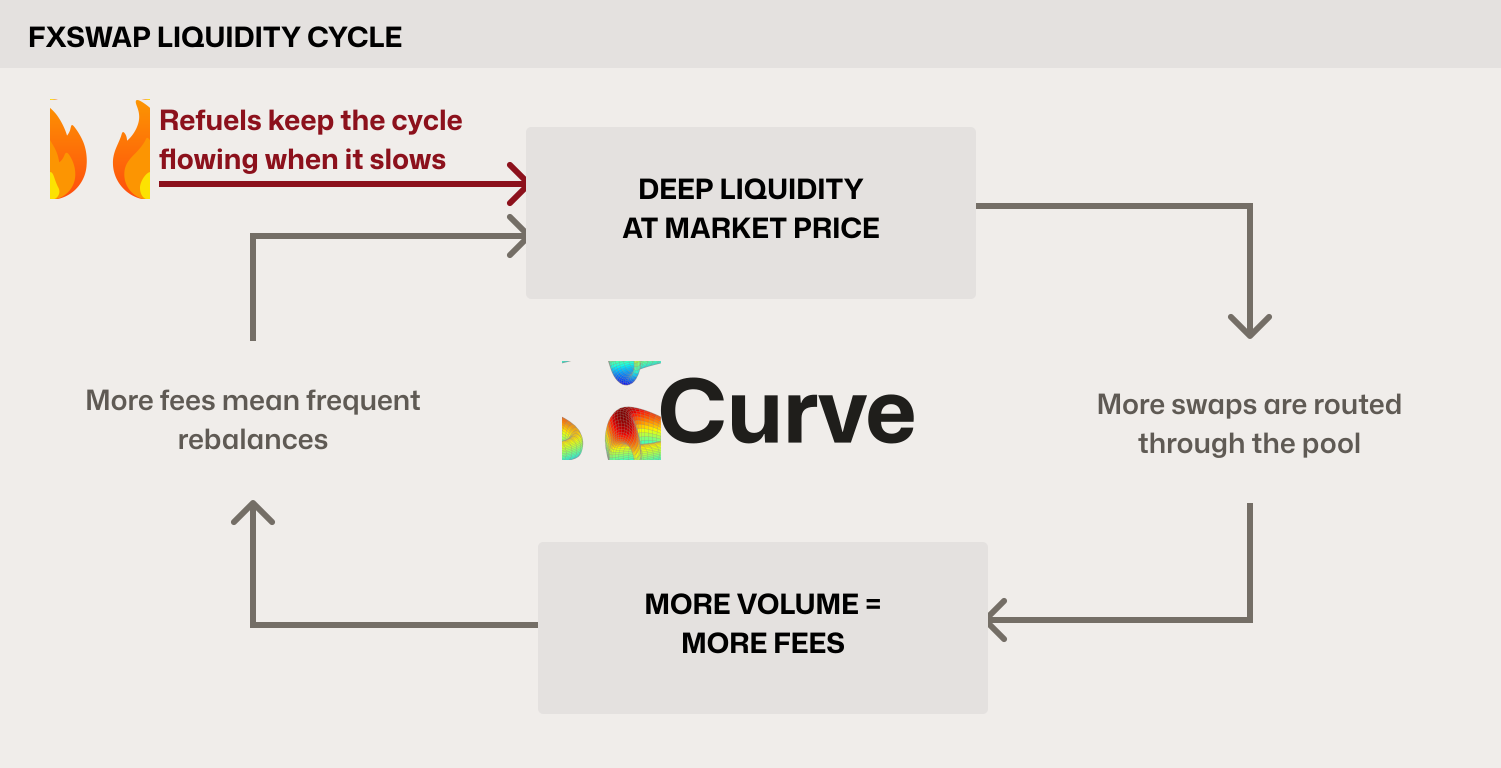
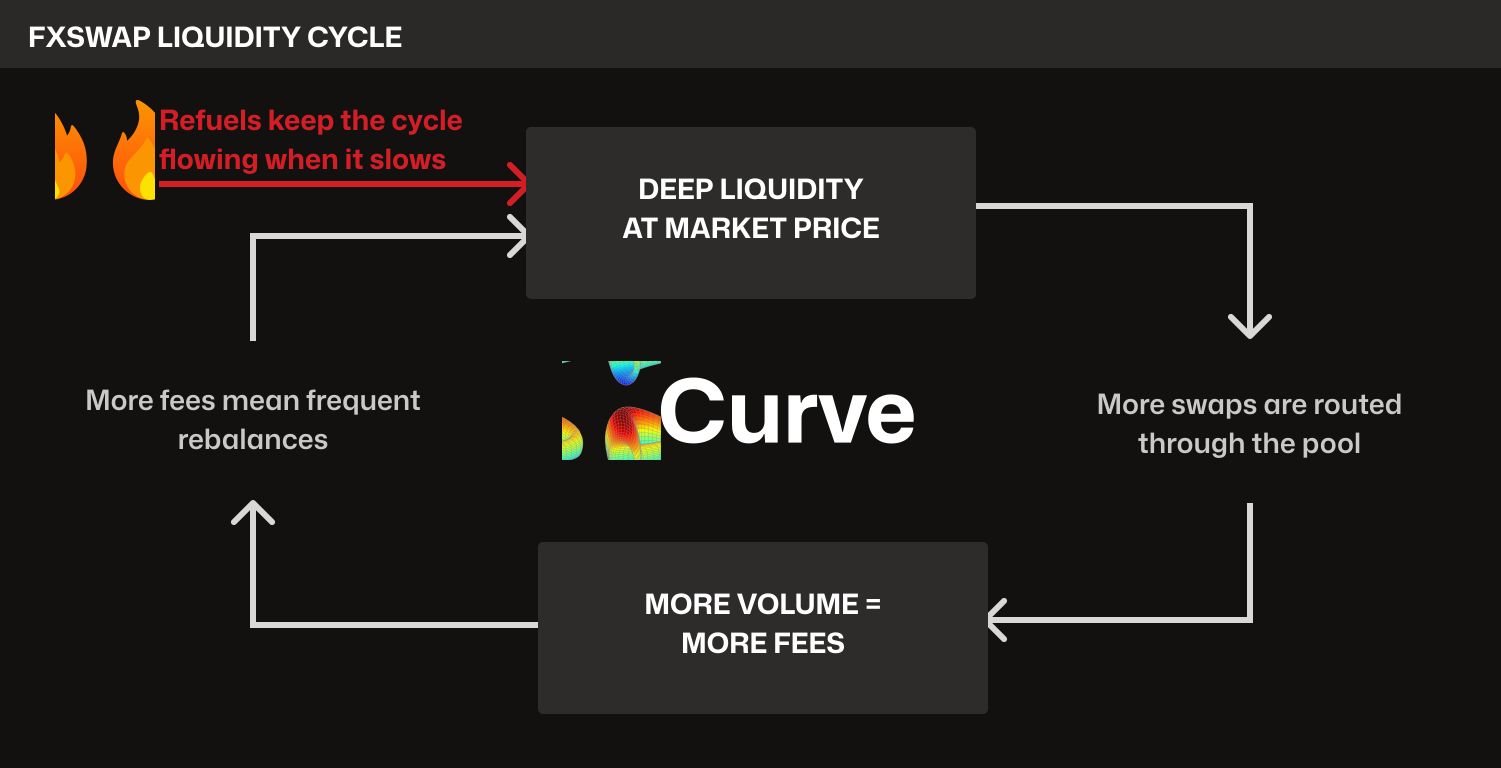
A): HigherAvalues create deeper liquidity, but increase the cost to move that liquidity when prices change. - Swap Fees: Higher volume generates more fees. A pool with more trading profit generally requires fewer external Refuels; the configured allocation must be read from that pool.
These factors interact with oracle smoothing, external market depth, and arbitrage costs. Protocol teams should backtest a proposed configuration instead of extrapolating a fixed percentage from another pool. See Mechanism and Parameter Design and FXSwap Simulations: Behind the Scenes for the design workflow and its limitations.
The resulting liquidity cycle is:
How Can I Refuel a Pool?
Refuels are added through the standard add_liquidity function using the deployed donation = true flag. A community UI is available at crvhub.com/refuel.
To set up recurring automated refuels, use the Donation Streamer — deposit tokens once and have them streamed into the pool on a schedule.
Can I add another Refuel while one is unlocking?
Yes. FXSwap pools track the total refuel amount within an unlock period (default 7 days) and calculate a continuous unlock rate.
Example (with 7 day unlock time):
-
Day 0: A $700 refuel is added, with an initial unlock rate of $100 per day.
-
Day 3: $300 has unlocked and $400 remains locked. If no recentering has burned shares, the full $700 is still outstanding.
-
Day 3: A new $1,400 refuel is added.
- New Total: $2,100 of refuel shares are outstanding.
- Preserved Availability: The $300 that had already unlocked remains unlocked.
- New Schedule: The remaining $1,800 unlocks over the next six days, an effective rate of $300 per day.
-
Days 4–9: More shares become available according to the new schedule. Any available shares burned during rebalancing reduce the outstanding refuel balance separately.
Can I use FXSwap without Refuels, or use Refuels only as a last resort instead of a Cryptoswap pool?
Yes, but be aware that FXSwap pools use the simpler Stableswap invariant (no gamma), so there is less fine tuning of the liquidity bonding curve available.
Parameters
Amplification Factor (A)
The amplification factor in FXSwap pools works similarly to the amplification factor in Stableswap pools, with one key distinction: the liquidity centers around a variable called price_scale rather than a fixed 1.0 peg.
Let's have a look at what this means in terms of balance in the pools and prices:
Gamma (gamma)
Gamma is unused in FXSwap logic. While the parameter exists in the smart contract ABIs, it is retained solely for backward compatibility, allowing integrators to use existing Cryptoswap patterns to interface with FXSwap pools.
Dynamic Fees
Dynamic fees adjust based on the pool's balance. Fees are lower when a swap helps balance the pool, and higher when a swap unbalances it. This is controlled by three parameters:
- Mid Fee: The base fee charged when the pool is perfectly balanced (e.g., 50/50 value ratio).
- Out Fee: The maximum fee, charged when the pool is entirely tilted toward one asset.
- Fee Gamma: Controls the steepness of the fee increase. A lower gamma results in a sharper rise from Mid Fee to Out Fee as imbalance grows.
Below you can see how these three parameters affect the shape of the dynamic fee that will be charged based on the value ratio of assets in a pool (e.g., $550k in ETH and $450k in crvUSD equals a 55/45 value ratio)
Further Reading
- FXSwap — dated execution-quality evidence and product context.
- FXSwap Simulations: Behind the Scenes — parameter search, historical backtesting, and limitations.
- FXSwap developer documentation — integration, mechanism, pool interface, and refuel automation.