Boosting CRV Rewards
This guide assumes you have already provided liquidity and are currently staking LP tokens on the DAO gauge. If you haven't done this yet, see our DEX liquidity provision guide or Llamalend supplying guide.
Locking CRV into veCRV can improve the return profile of a Curve position in several ways. The boost calculator at the bottom of this article helps estimate the CRV reward boost for a specific gauge, while also showing an estimated crvUSD revenue share based on recent veCRV holder revenue.
What Locking CRV Unlocks
Locking CRV gives users three protocol-level benefits:
- Boosted CRV rewards: veCRV can increase CRV rewards on staked LP positions by up to 2.5x, depending on the gauge and the user's share of veCRV.
- crvUSD revenue share: veCRV holders receive a share of crvUSD protocol revenue. The calculator estimates this using recent DefiLlama holders-revenue data.
- Governance and gauge voting power: veCRV gives voting power in Curve DAO governance and gauge weight votes, which influence where CRV emissions are directed.
These benefits are related but separate. A user can use veCRV to boost liquidity rewards in a gauge and still receive protocol revenue share from veCRV ownership.
How Rewards Are Displayed
In Curve's interface, rewards are always displayed as a range showing the difference between unboosted rewards (for regular liquidity providers) and maximum boosted rewards (for veCRV holders). This range helps you understand the potential value of holding veCRV.
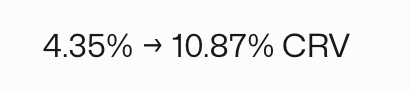
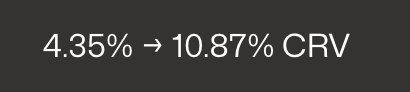
Only CRV rewards are boosted by veCRV. External reward tokens (like tokens from other protocols) are distributed solely based on your liquidity share and are not affected by veCRV holdings.
Step 1: Review Required veCRV
The first step to getting rewards boosted is to determine how much veCRV you need. Each gauge has different requirements, meaning some pools are easier to boost than others. This depends on:
- The amount of veCRV others have locked
- The total value staked in the gauge
- Your future share of staked LP tokens in that gauge
Use the calculator below to compare how much veCRV you have, or plan to lock, against the amount needed for maximum boost.
Step 2: Lock CRV for veCRV
After determining how much veCRV you need, visit the CRV Locker to create your lock. For detailed instructions on locking CRV, see Locking CRV & Managing Locks.
Step 3: Check Your Boost
Open your Ethereum pool from Your Positions on the Pools page, then select Liquidity Details on the pool page. Your current multiplier appears under veCRV Boost.
Troubleshooting Boost Updates
- ✅ If the new boost is visible under veCRV Boost, then no further action is required.
- ⚠️ If the current boost hasn't updated, try claiming CRV from each of the gauges where you have liquidity. This should trigger the boost update.
Boosts are only updated when you make a withdrawal, deposit, or claim from a liquidity gauge. This is why claiming rewards can help refresh your boost display.
How the Boost Formula Works
Your boost multiplier can be between 1 and 2.5. This means if you have a 2.5x boost and deposit $10,000, your rewards are calculated as if you deposited $25,000. It depends on the following factors:
- Your veCRV balance: More veCRV means a higher potential boost.
- Your future share of staked LP tokens in the gauge: Your boost is calculated relative to the share of gauge-staked liquidity your position will represent after staking.
- The voting supply and staked liquidity in the gauge: The boost mechanism balances your voting power against everyone else's staked LP tokens in the Pool or Lending market's gauge. Ethereum gauges use Ethereum veCRV; L2 gauges use their chain's veCRV oracle.
By boosting, you're essentially getting a larger share of the new CRV tokens distributed. This incentivizes users to lock CRV, which in turn strengthens the Curve DAO's governance and promotes long-term alignment with the protocol.
The Boost Formula
Formula Variables:
- = Your rewards boost (capped at 2.5x maximum)
- = Your deposited value in USD
- = Future total value staked in the reward gauge in USD, including your deposit if it is a new position
- = Your veCRV amount (vote weight)
- = Voting supply used by the selected gauge (Ethereum veCRV on Ethereum, or the L2 veCRV oracle on a supported L2)
Estimate Your Boost And Revenue Share
Use this calculator to estimate the boost for a specific pool gauge before connecting a wallet. It compares your share of the selected gauge's voting supply with your future share of its staked LP tokens. L2 estimates use the selected chain's veCRV oracle, which may take time to reflect a new Ethereum CRV lock. The crvUSD revenue-share estimate always uses Ethereum veCRV and recent DefiLlama holders revenue; it is not guaranteed yield.
Select a pool gauge
Pick the gauge where your LP tokens are or will be staked.
Gauge contract details
Enter or load your position
Paste an address to auto-fill a current position, or enter your LP token amount manually.
LP token price is unavailable for this gauge, so the calculator needs a USD estimate.
Advanced boost inputs
Current USD value staked in this gauge, not total pool liquidity.
Selected chain L2 VotingEscrow Oracle supply denominator.
Future gauge share uses current staked TVL plus your deposit.
Enter veCRV or CRV lock details
Use current veCRV if you already locked CRV, or estimate veCRV from a planned CRV lock.
CRV price unavailable.
Years, capped at 4 for max veCRV.